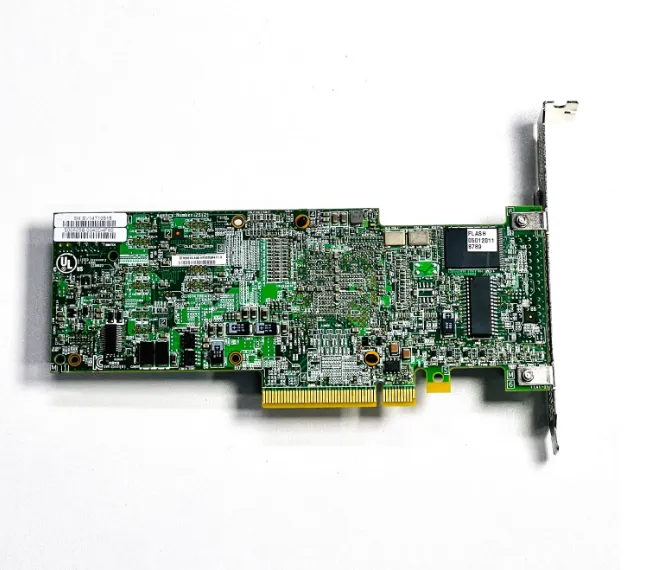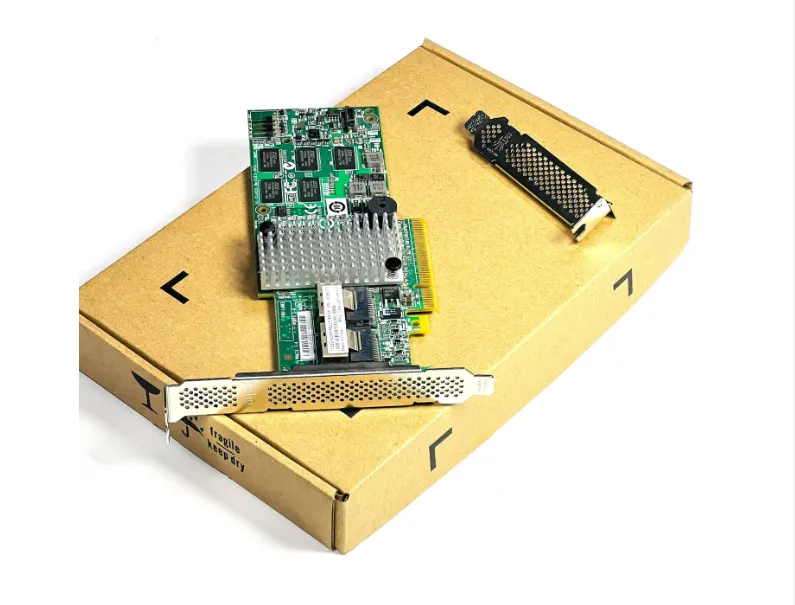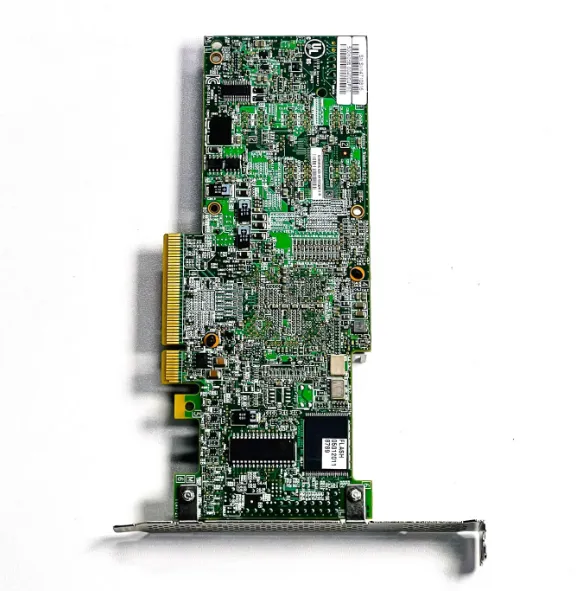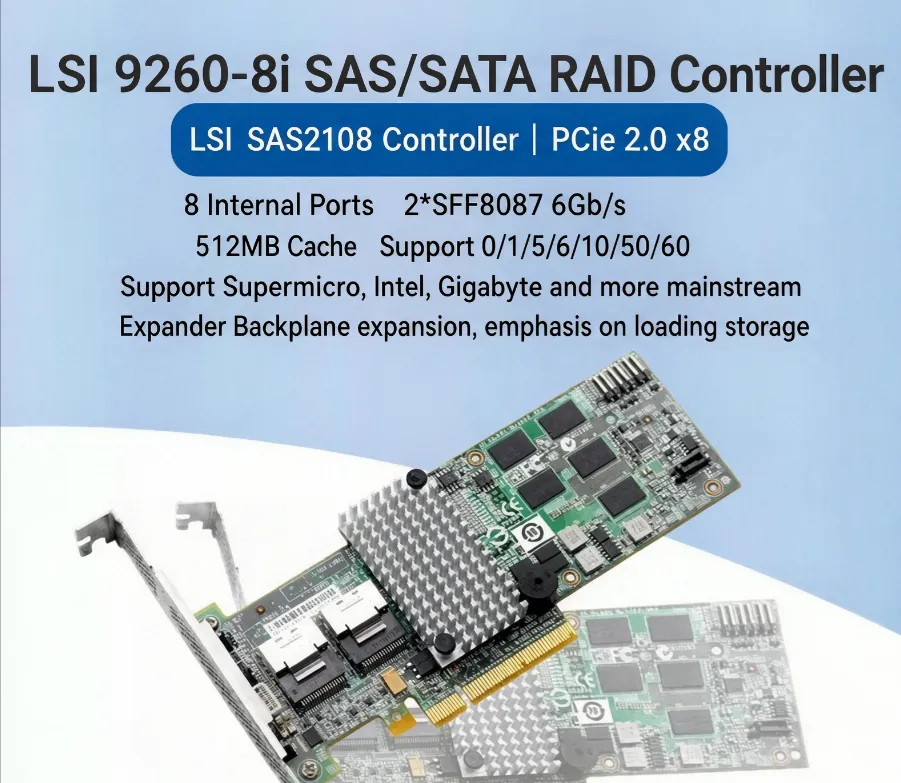
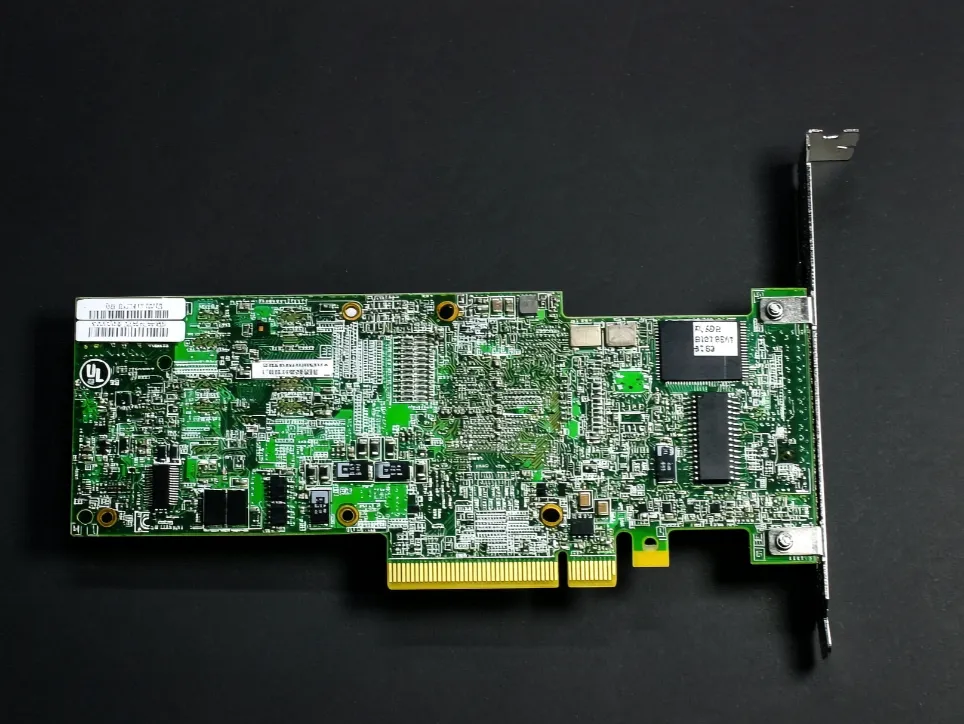

Let’s be honest — nobody gets excited about a RAID controller. You don’t dream about one, you don’t show it off, and you only ever think about it on the day something goes wrong. You buy one because something has to hold your data together, and you want that something to be dependable enough that you never think about it again. That’s precisely the job the LSI MegaRAID SAS 9260-8i was built for, and even though it’s a 2010s-generation part, it still does that job better than most of what you’ll find at this price. Under the heatsink sits the LSISAS2108 RAID-on-Chip, an 800MHz PowerPC core that crunches all the parity math in hardware instead of dumping it on your CPU. You get eight internal 6Gb/s SATA+SAS ports through two Mini-SAS SFF-8087 connectors, 512MB of 800MHz DDRII cache, and a PCIe 2.0 x8 host link — and if you hang a SAS expander off those two connectors, the drive ceiling climbs all the way to 128 devices. In plain terms, your host processor stops babysitting parity calculations and gets back to running your actual workloads.
Where the card really earns its keep is flexibility. It covers all seven RAID levels — 0, 1, 5 and 6, plus the nested spans 10, 50 and 60 — and RAID 6 is the one worth singling out, because it survives two simultaneous drive failures. That matters more than most people think: the riskiest moment in any array’s life is the rebuild, when you’ve lost one disk and every remaining drive is being hammered at full tilt, and that’s exactly when a second disk tends to give up. We’ve all seen it happen, and it isn’t pretty. Better still, you’re not married to your first decision. Online Capacity Expansion and Online RAID Level Migration let you add drives or shift an array from RAID 5 to RAID 6 while everything stays live, which means no downtime and no 3 a.m. maintenance window to negotiate with anyone. The 512MB of onboard cache is the other half of the story, and here’s the honest part: write-back cache is genuinely fast, and it’s also the thing that will eat your data if the power drops mid-write. That’s why the optional iBBU07 battery backup module exists — it keeps the cache alive long enough to flush to disk. Card plus battery is a real performance story; card without battery is a gamble, and you should know which one you’re buying.
The software options are where this “old” card starts to feel unfairly good. FastPath is tuned specifically for SSD arrays, with LSI claiming up to 3× the IOPS of the previous generation on small, random, transaction-heavy workloads. CacheCade flips the script and lets you park an SSD in front of a wall of spinning disks, turning it into up to 512GB of controller-level cache with read improvements of as much as 50× on read-intensive jobs like file serving, web serving, OLTP and databases — which is a genuinely cheap way to make an old array feel new. SafeStore rounds it out with self-encrypting drive support and Instant Secure Erase, so decommissioning a disk becomes a matter of changing a key rather than shredding a drive. All of it is driven from the MegaRAID Management Suite: Storage Manager when you want a GUI, WebBIOS when you need to configure before the OS even boots, and MegaCLI when you’d rather script the whole thing. Setup is refreshingly un-scary — most people have a working array in well under half an hour.
So who should actually buy one? Home-lab builders and NAS tinkerers who want genuine hardware RAID instead of motherboard fakeraid. Small businesses squeezing more useful life out of a perfectly good 6Gb/s backplane. Anyone working in a 1U or 2U chassis, since the MD2 low-profile board measures just 6.6″ × 2.536″ and fits where a full-height card simply won’t. And honestly, anyone who needs RAID 6 with battery-protected cache without signing off on a four-figure invoice — these routinely show up on Chinese marketplaces for well under a hundred dollars. Who should keep scrolling? If you’re building an all-NVMe box, or you need 12Gb/s SAS, this is not your card and it isn’t pretending to be. It’s 6Gb/s SAS 2.0 over PCIe 2.0, and it’s comfortable with that. Which brings us to the bottom line: eight ports, seven RAID levels, hardware parity on a dedicated ROC, plus optional battery-backed cache, SSD acceleration and encryption waiting in the wings. The LSI MegaRAID SAS 9260-8i does the deeply unglamorous work of keeping your data alive, and it does it without drama. If you’ve got one slot left in that chassis, drop a 9260-8i in it — and then go back to never thinking about it again.